To develop the script further, I've been doing more research, mainly focusing on the technologies that people use to access their social networking sites. Here are a few of the links:
Android timeline
Average facebook user
Social Media charts and graphs
Monday, 20 February 2012

Friday, 17 February 2012
Here's some more history...
Since we are having a timeline of the history of social networking, I am doing some more research to help me write the script. Here are some useful links I found:
Cool Stylised timeline
Basic history
Facebook facts
2012 stats of facebook
UK based facebook figures (telegraph article)
It is really quite interesting :)
Cool Stylised timeline
Basic history
Facebook facts
2012 stats of facebook
UK based facebook figures (telegraph article)
It is really quite interesting :)
Wednesday, 15 February 2012
The ever evolving idea!
Once again the live action beginning of our idea has changed. Due t the lack of people willing to help us again, we have decided to change the idea. In week 4, we decided that we would make the guide (narration) looking back on 2012 from 2022 to show how social networking has developed. This is the basics of what is happening in our new starting scene:
AJ walks down the street with his glasses on, the augmented reality working on people walking by. He goes to his front door and opens is (the reverse shot will be the transition from 2022 and 2012) the glasses will have disappeared off his face. He goes to sit down on the sofa and gets his phone out. In the screen is where the title appears and then it will zoom into the screen for the start of the animation.
This is the final idea change! Filming is starting friday...
AJ walks down the street with his glasses on, the augmented reality working on people walking by. He goes to his front door and opens is (the reverse shot will be the transition from 2022 and 2012) the glasses will have disappeared off his face. He goes to sit down on the sofa and gets his phone out. In the screen is where the title appears and then it will zoom into the screen for the start of the animation.
This is the final idea change! Filming is starting friday...
Tuesday, 14 February 2012
30 years of social networking?!
I did some research today, to help the development of the script I am working on. I found this website that you can access by clicking here. It shows that social networking has been around for over 30 years and did not start with computers, but with hacked telephones to send information to each other. It is really interesting and thought it deserved a post on the blog.
Monday, 13 February 2012
Change of beginning
Today we were supposed to be filming, however we turned up and only 3 people had appeared to help us. This meant that we couldn't do the filming as we did not have anywhere near enough people. We tried rescheduling with Varsity, who were restricting the time in which we could film, only 9-10am.
It made us then think that we should change the environment in which we should film, somewhere that could still be a social environment but also one in which we could control realistically. We have changed the scene at the beginning to instead be in a bar, but be at a house party. This means we have full control over lighting, times to film and how many people needed to fill the space.
It made us then think that we should change the environment in which we should film, somewhere that could still be a social environment but also one in which we could control realistically. We have changed the scene at the beginning to instead be in a bar, but be at a house party. This means we have full control over lighting, times to film and how many people needed to fill the space.
Sunday, 12 February 2012
The friendships refined
This week I managed to refine the characters friendship web, to focus mainly on our principle areas and to make it less complex. Here is what was drawn on my blackboard:

It has also changed slightly since this was drawn over a week ago.

It has also changed slightly since this was drawn over a week ago.
Week 5
We did some location scouting on monday 6th for the filming tomorrow. We are filming the live action sequence for the beginning, with AJ walking in with his glasses on looking for his friends. Here are the photos of our area:


We have some extras and our main parts planned to come in early in the morning, hopefully enough to fill out the space.


We have some extras and our main parts planned to come in early in the morning, hopefully enough to fill out the space.
Thursday, 2 February 2012
Proposal presentation
Today we did a presentation of our proposed idea, the link to which is here.
We got some useful feedback from our peers such as how are you going to get it all in without it being too complicated? What are you focusing on? etc. It made me realise that we are getting too wrapped up in our research and that the film needs planning out now, and to evaluate our results so far so we can decide which topics are going in.
We got some useful feedback from our peers such as how are you going to get it all in without it being too complicated? What are you focusing on? etc. It made me realise that we are getting too wrapped up in our research and that the film needs planning out now, and to evaluate our results so far so we can decide which topics are going in.
Tuesday, 31 January 2012
Week 4
For some primary research, I decided to watch the types of Facebook statuses that 3 randomly chosen people had been posting. I also looked at their activity on other peoples profiles and the general activity they decided to show.
Person 1: Female, 792 facebook friends
Person 1: Female, 792 facebook friends
All within a week period, 5 profile picture changes [all either posed or on a night out] within this space she had posted at least 7 posts a day talking about money, going out, her planned trip, how other people find her attractive, alcohol and moaning she has no friends. Also commented on every person she could status eg. Someone asked a friend how she was doing and she jumped in on the status saying hi to the original poster and then taking over the comments to put forward how well she's doing. She also particularly took the piss out of one ‘friend’ by posting embarrassing pictures/comments and involving other people in commenting on them, in the process of picking on other members of the group who don’t have facebook.
Person 2: Female, 1550 facebook friends
Average of at least 10-15 posts a day- tend to be contridictary. Eg. About how much she loves this guy, now he wont pay attention to her, that she doesn’t need a relationship and then again is upset and blames all males. At least one new picture of herself is posted everyday, if no comments, she asks for them or reposts the picture. Lots of attention seeking posts saying so sad ‘she could cry’.
Person 3: Male, 2241 facebook friends
Average of 1-2 posts every 1-2 days. Tend to be funny and witty statuses with lots of attention (average of 60+ likes). Tends to draw on popular culture, internet trends or current affairs so there is a common ground with people. He also tends to ‘poke fun’ at the usual facebook updates and comments from annoying people on his feed.
Sunday, 29 January 2012
Online questionnaire
After looking at some research already been done in the books I am reading, I want to collect some information of my own. So I have created an online survey for anyone to fill out.
www.surveymonkey.com/s/HTYC5HY
It would be muchly appreciated if you could spare 2 minutes to fill it out for me :)
www.surveymonkey.com/s/HTYC5HY
It would be muchly appreciated if you could spare 2 minutes to fill it out for me :)
Friday, 27 January 2012
People who don't use facebook?!
All of my research has focused around people who use social networking sites but I feel I have been neglecting members of our target audience that do not engage with them. As a form of personal research, I have contacted a friend who does not use facebook. His reason for not using it is:
" I don't use it for that fact it takes up too much time, and you also talk to bullshit people who aren't really friends. My sister made a bet that I couldn't go on it for a few years too so I did it for that reason too." (19 years old)
He uses twitter instead, but is not an excessive user, mainly for talking to people rather than leaving statuses about himself. He also had a friend that does not use facebook, twitter or any other social networking site. I was also told he has a phone without a camera. He said:
"I can't be arsed with the whole friend thing, when most people on there are idiots, everyone I want to talk too is in my phone book." (21 years old)
More research
From the same book as before (A Networked Self) I found some more information on online addiction and more facebook facts.
Online use and addiction:
- 75% of young adults online (16-24) have an online profile.
- Media habit (definition) A form of automaticity in media consumption that develops as people repeat media consumption behaviour in stable circumstances.
- 6% of US adults said a relationship suffered because of their internet use.
- Internet usage disorder is now classed as a category of mental-illness.
- 2 problematic media habits:
Problematic Internet Use: As compensation for social incompetence in the offline world. Dimensions are- mood alteration, social benefits, negative outcomes, compulsivity, excessive time, preoccupation and interpersonal control. Social benefits are an early positive but then people start missing real life events, so the cycle continues (go online for more social interaction). This accounts for 10% of cases.
Socio-cognitive model of unrelated media use: Describes how humans exercise or lose control of media behaviour. Their self- regulatory behaviour becomes impaired and self-control over media is diminished. Other symptoms lack of awareness and attention.
- Evidence to say that social networking is not for making new friends but to articulate and reflect offline relationships. 91% of teens in the US do it to connect with current friends.
Facebook:
- Female respondents, on average, visited facebook more often than males but once on the site, there was no difference between genders on how much time they spent on.
- From an experiment, females are more intense users of social networking sites.
- Students that do not live with their parents are more intensely engaged with social networking sites.
- College students consciously upload and tag displayed photographs, thus selecting certain subjects and events to emphasize.
- People are able to post that information which presents a desired image.
- Social networking sites are about establishing, presenting and negotiating identity, through the tastes and interests expressed, through applications we add and through pictures of us and friends. These identity presentations are supported by comments from other users.
- Most users do post pictures of themselves and friends, with females doing this more than males.
- Facebook in 2009 reported more than 1 billion photos were uploaded every month.
- “Recording an event has become part of that event- and perhaps the most important part.” Most subjects pose in front of the camera, looking down the lens and are highly aware of the camera. We therefore consciously and unconsciously transform ourselves before the camera.
Wednesday, 25 January 2012
A networked self
I have been doing some more reading, concentrating on the internet and how people interact on it. One of the 3 books I took out is:
A Networked Self: Identity, Community and Culture on Social Networking Sites
Edited by Zizi Papacharissi (2011)
Oxon, Routledge
Here is some of the information I found:
General internet information:
- An experiment was conducted to see if the random nature of the internet meant we networked in different ways. The results showed very similar searches/sites and sites like Google etc, act like Hubs (like large airports)
- Media convergence- people can watch videos while chatting on Instant Messenger services
- There is also simultaneous communication on mass and interpersonal media (eg. Reading an article on a newspaper website, while chatting on msn, while reading the same issue on a blog and then looking at the comments on the post.)
- The manner of reception alters peoples relationship/communication online, either through mis-representation, processing filters or biases.
Facebook information:
- Not just group identification and social idenities, but we can see what an individual person is doing/ where they are.
- The average facebook user has 250-275 friends compared to 10-20 close friends in traditional relationships.
- Someone can co-create a facebook profile by posting a comment on someones timeline. Could it have an influence on how people see you? (posting gossip, embarrassing comments or drunken pictures)
- Facebook wall posts: are they affected knowing that a personal message is made public not just to your friends, but their friends? Eg. Exclusivity language, types of pictures you post, self-promotion.
Group dynamics online:
- Do comments from other users affect the perception of the material, eg. Youtube video? And does the lack of identity/ personal information on Youtube affect the type of comments posted.
- In an experiment: people preferred people recommended stories online than editors choice, features etc.
A new style approach for the animation
Today, we talked over our visual style again, after watching and researching several videos, films, photos etc. We have decided to keep our initial idea of the Hitchhikers Guide to the Galaxy style animation when we go into our networking section, using a blank canvas to help us map out our networks of people. However, we want to incorporate a 3D image, using the space to set out our idea more sophisticated and styled. Our inspiration is the starting video from Call of Duty: Modern Warfare 3
This style will allow us to create something modern/futuristic without being too cliche on 'future styles'. Also, it will help with animating that section easier. Other styles we talked about was Iron Man and Lost in Space.
We have also decided that the colour blue will be prominent in our project, as these tend to be the colour on social networking sites, such as facebook but also in the books we have been looking at as all of the visual representations of online networks have been drawn in blue.
This style will allow us to create something modern/futuristic without being too cliche on 'future styles'. Also, it will help with animating that section easier. Other styles we talked about was Iron Man and Lost in Space.
We have also decided that the colour blue will be prominent in our project, as these tend to be the colour on social networking sites, such as facebook but also in the books we have been looking at as all of the visual representations of online networks have been drawn in blue.
Slight idea change...
Yesterday, our idea developed further. Initially, we were going to use a phone to demonstrate this augmented reality, however, people can do that on their phones now, which does not fit into out 5-10 years into the future. So we have decided to do the beginning as a point of view and the device will be glasses that has a button that switches on the augmented reality. The effect on these glasses could be like a style I saw in Black Mirror, to signal to the audience that the character had switched to this ‘video mode’ in his eyes.

We discussed this idea in great depth and then asked someone that was in the age range what they thought of the initial ideas. Without being prompted about anything we wanted the audience to feel/ know, he said that using the glasses would be a good way of showing that this isn’t in the distant future, and it was a good relevant topic that might make people think about how they use technology. This made us feel that we are on the right track and all the research we have done so far is relevant.
Week 3 research
As to do some research on our audience, we have decided to use the very technology that we are using in the project (eg. Facebook and general online systems).We want to see how people of our target audience (16-25) use social networking and other technologies such as mobile phones to contact each other and the amount in which they use it. We will be creating an online questionnaire to help us further understand how people use it now and where they see it going in the future.
Sites we could use include:
Initial visual style idea
Looking at our concept of using a future, but not so far in the future approach, we need to develop a visual style for looking at the world in a futuristic way. My looking through our camera or phone device we need a way of switching through personas etc. Below is an image from 'Black Mirror- The Entire History of You' that aired on Channel 4:

This shows a practical yet stylised way of representing flicking through different 'costumes' or identities.
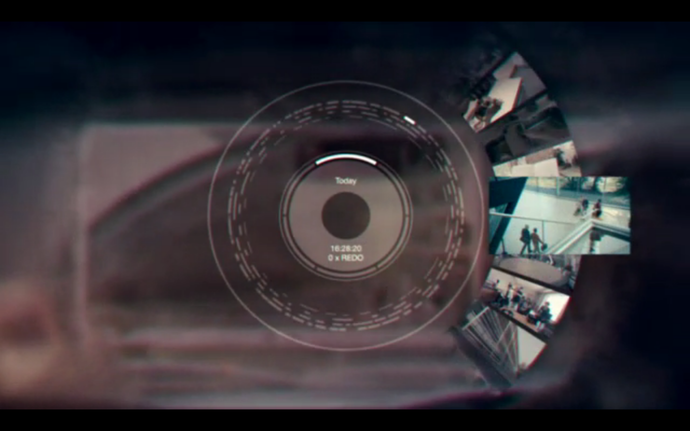
This shows a practical yet stylised way of representing flicking through different 'costumes' or identities.
Let the reading commence...
For the project to have substance, we decided that we need to look at more academic texts and to really understand the issues we are tackling. I took the social dynamics, specifically looking at online presences and theories as my topic of research. The first book I looked at was:
Identity in Britain: A cradle-to-grave atlas
Bethan Thomas and Daniel Dorling 2007
The Policy Press
Bristol
The identity chapter looked at how people are identified in general:
People are normally identified by (in order):
gender
age
role (in families- mother, sister, daughter and in work- friend, colleague, boss or mate, lover, acquaintance)
nationality (English)
racial
social class
geographical location
occupation
religion
An interesting term found was The Human Mosaic. It looks at the different levels of humans and locations in the world, from an individual to a crowd to a stadium, to the city, to the area, to the country etc.
(“Each place is a story of thousands of stories, a composite, collage, collection, a human mosaic”)
This could be used for the name or just use this theory to help structure our project.
Tuesday, 17 January 2012
Week 2 research
Thinking on the technology angle, I did some research and found out about augmented reality and how it is taking off. On my phone I have Layar, an app that was pre-installed on my phone that allows you to see the world in a whole different way through your camera. You turn the feature on and hold it up to an environment, then digital displays such as restaurant reviews and star ratings will appear on your screen. The company website is here and there is an interesting blog about what other things that augmented reality can be attached too, such as the work they did for Rolling Stone magazine where people pointed their phones at random covers of the front page of the magazine spread around New York, and they got to watch videos with the stars on their phone.
Something to be thinking about, especially since this technology is starting to become part of consumer products like phones.
Something to be thinking about, especially since this technology is starting to become part of consumer products like phones.
Monday, 16 January 2012
Idea Development
This morning, Dave and I came up with an initial concept for our project. After doing some research over the weekend we decided to create a film based on how technology is used to develop our relationships and how it can distort this.
*Initial opening idea* In a pub environment, someone pulls up an app on a phone like Layar and we see the augmented reality. We scan the pub, with peoples profiles appearing around them, such as an old man sat reading a newspaper with 'No profile found' and 2 people together on a date, it pulls up their facebook profiles- one is in a relationship and one isn't.
*Initial opening idea* In a pub environment, someone pulls up an app on a phone like Layar and we see the augmented reality. We scan the pub, with peoples profiles appearing around them, such as an old man sat reading a newspaper with 'No profile found' and 2 people together on a date, it pulls up their facebook profiles- one is in a relationship and one isn't.
Thursday, 12 January 2012
It's a starting point...
During our first workshop back after christmas, we received some feedback about our presentation. From the conversation our idea dramatically developed, we just needed a a starting point to go from.
The notes from the conversation went on the lines of social structures within society, but particularly with the modern age, such as uses of facebook/ internet and technology in general and how these structures are changing. We could go various ways with it, from how someone can change their whole presence and identity online and how they can erase their past, or how others perceive each other or how social structures are formed.
One of the most recent TV shows that I have seen (Black Mirror- The entire history of you) was an example that I cited, as their life is run by technology and they see people in a different way.
Here is the first section of the show
The notes from the conversation went on the lines of social structures within society, but particularly with the modern age, such as uses of facebook/ internet and technology in general and how these structures are changing. We could go various ways with it, from how someone can change their whole presence and identity online and how they can erase their past, or how others perceive each other or how social structures are formed.
One of the most recent TV shows that I have seen (Black Mirror- The entire history of you) was an example that I cited, as their life is run by technology and they see people in a different way.
Here is the first section of the show
Subscribe to:
Comments (Atom)